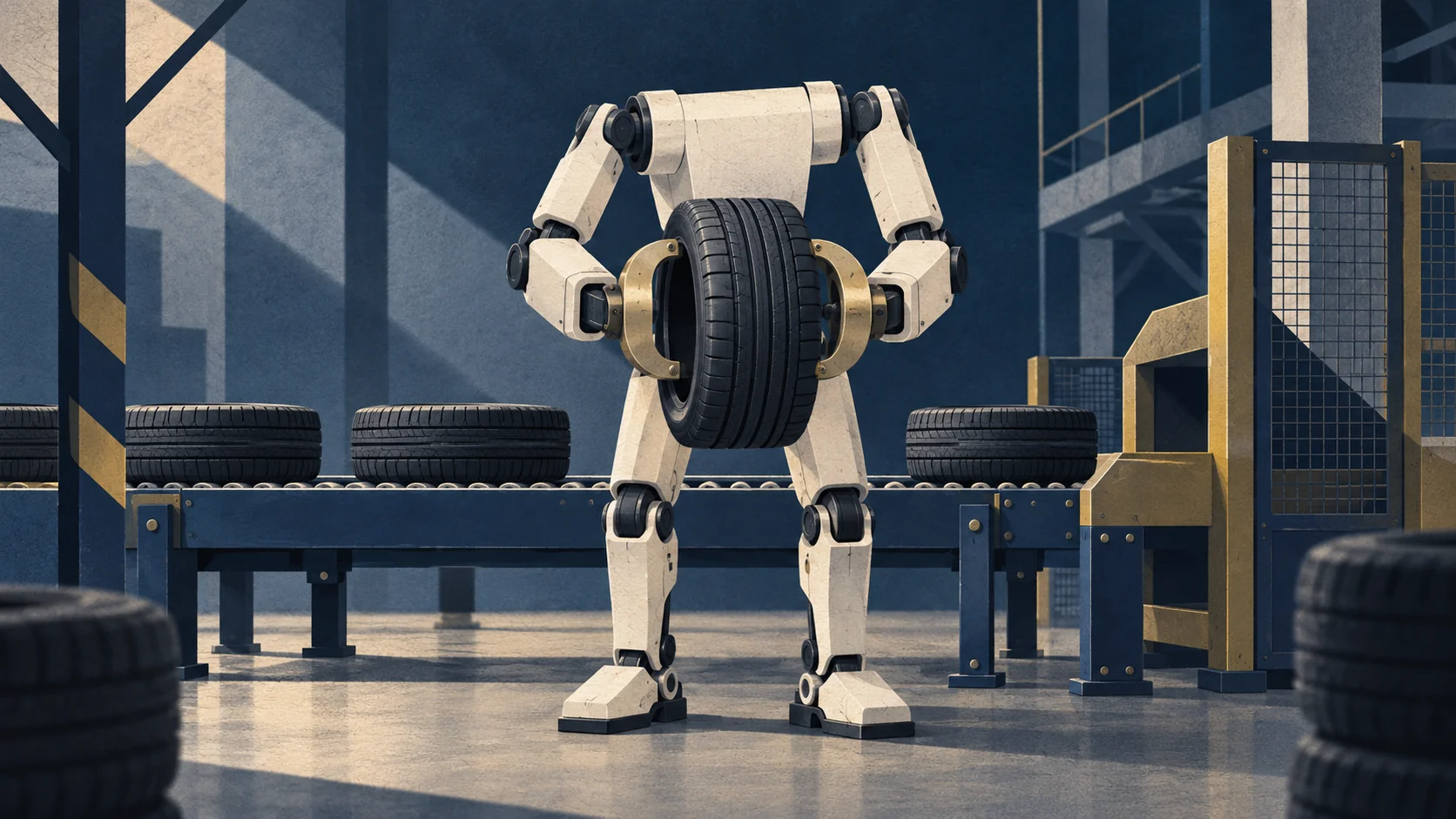
Correction added 16 October 2026: The executive summary incorrectly described all 350 robots as already operating at Douai. Renault's March announcement described a planned rollout. Its 26 June 2026 account subsequently described Calvin testing at Douai and a roadmap towards 350 robots by the end of 2027. That later account is identified here as subsequent context, not information available at the March publication date.
Most humanoid robot programmes chase generality. Renault is chasing repetition. Its futuREady plan announced on 10 March 2026 included a planned rollout of 350 new-generation humanoid robots for heavy work and repetitive tasks. That commitment was a deployment target, not a count of robots already operating at Douai. Calvin's task-constrained design makes tyre handling and material movement the immediate focus.
Executive Summary
- Planned rollout: Renault announced a 350-robot programme. Initial Calvin work at Douai was distinct from that future fleet; the source did not establish that all 350 units were operating there.
- Constrained by design: Calvin-40 lifts 40 kilograms and was co-developed with Wandercraft, a Parisian medical exoskeleton firm, in a reported 40-day development cycle. The headless form factor rejects general-purpose ambition in favour of task-specific reliability.
- Industry convergence: BMW, Amazon, and Google DeepMind all announced humanoid manufacturing initiatives in March 2026, while Gartner predicts fewer than 20 companies will reach production-scale humanoid deployment by 2028.
From Exoskeletons to Assembly Lines
Calvin's lineage runs through hospital corridors, not research labs. Wandercraft, the Parisian robotics firm behind the hardware, built its reputation on medical exoskeletons designed to help paraplegic patients walk. Renault invested US$75 million for a minority stake in Wandercraft in June 2025, and the first Calvin unit reached the Douai factory floor by April 2025. Biomechanical expertise in balance, load-bearing, and unpredictable human movement translates directly to factory logistics where floor conditions, obstacle avoidance, and payload stability matter more than fine-motor dexterity.
Calvin-40 manages loads up to 40 kilograms several hundred times daily, running on NVIDIA's Isaac robotics platform with Jetson edge computing and visual language models for task reasoning. Renault's futuREady plan targets a 30% reduction in production hours per vehicle, a 20% cut in production costs, and a 25% decrease in factory energy consumption by 2030. Calvin's deliberate constraints are part of that calculus: circular hands instead of dexterous fingers, no head, no pretence of general intelligence.
"There are no robots replacing people on the final assembly line, where you put all the parts in the car, because [they lack] speed and dexterity." — Thierry Charvet, Chief Industry Officer, Renault Group
Wandercraft's reported 40-day development cycle from concept to second-generation operational unit suggests an iteration speed that traditional industrial robot integration cannot match. For operations teams accustomed to multi-quarter procurement and commissioning timelines, that cadence reframes how quickly humanoid automation can move from evaluation to deployment.
Why Humanoid Robots Are Reaching Manufacturing Scale
Renault is not operating in isolation. BMW launched trials of the AEON humanoid at its Leipzig plant in March 2026, while also running Figure AI units at Spartanburg. Amazon acquired humanoid startup Fauna Robotics the same week. Google DeepMind partnered with Germany-based Agile Robots to combine Gemini AI models with industrial-grade robotic manipulation. Toyota Canada signed what Agility Robotics called the first commercial Robots-as-a-Service agreement for Digit units on its RAV4 production line in Woodstock, Ontario.
Each of these deployments constrains the humanoid form to specific, repetitive tasks rather than pursuing the general-purpose dexterity that dominates stage demos and investor decks. Even BYD, which targets 20,000 UBTech humanoids by 2026, focuses them on narrow manufacturing operations rather than flexible assembly.
Five major humanoid manufacturing announcements in a single month does not prove a paradigm shift. But capital is flowing into production-ready hardware rather than research prototypes. Goldman Sachs projects the humanoid robot market at US$38 billion by 2035. McKinsey's October 2025 analysis, "Crossing the Chasm," characterised the sector as pre-commercial. Renault's planned 350-unit rollout signals an ambition to scale; an announcement alone does not establish that production-scale deployment has been achieved.
As Washington's new Robotics Commission acknowledged, the automation density gap between Western manufacturers and Chinese competitors continues to widen. Renault's commitment, alongside the unprecedented capital flowing into factory-floor AI and robotics, signals that European OEMs recognise the competitive urgency.
What This Means for Manufacturing Leadership
The question for technology and operations leaders is no longer whether humanoid robots will reach the factory floor. Calvin is already there. The question is whether to specify for breadth or depth.
Renault's answer is unambiguous: constrain the task, compress the development cycle, deploy at scale before general-purpose platforms mature. Manufacturing organisations managing material-handling bottlenecks, particularly in tyre logistics, heavy component staging, and repetitive load transfer, should assess whether this task-specific model applies to their own lines. The 40-kilogram payload threshold covers a significant proportion of manual handling tasks in automotive and general manufacturing.
Gartner's forecast that fewer than 20 companies will achieve production-scale humanoid deployment by 2028 frames the competitive window. Manufacturers who wait for a versatile humanoid that handles every task will wait longer than those willing to deploy a constrained machine that handles one task reliably. Renault bet on constraint. The Douai plant is already collecting the data on whether that bet pays off.
Source: French carmaker to deploy 350 humanoid robots for logistics and heavy tasks in factories Category: Autonomous Robots | Impact: High Impact | Pillar: Industry 4.0