The US government has acknowledged, in formal institutional terms, that it is losing the industrial robotics race. The acknowledgment comes in the form of a commission, the National Security Commission on Robotics for Advanced Manufacturing. But the numbers behind its creation are the real story.
The Gap That Made a Commission Necessary
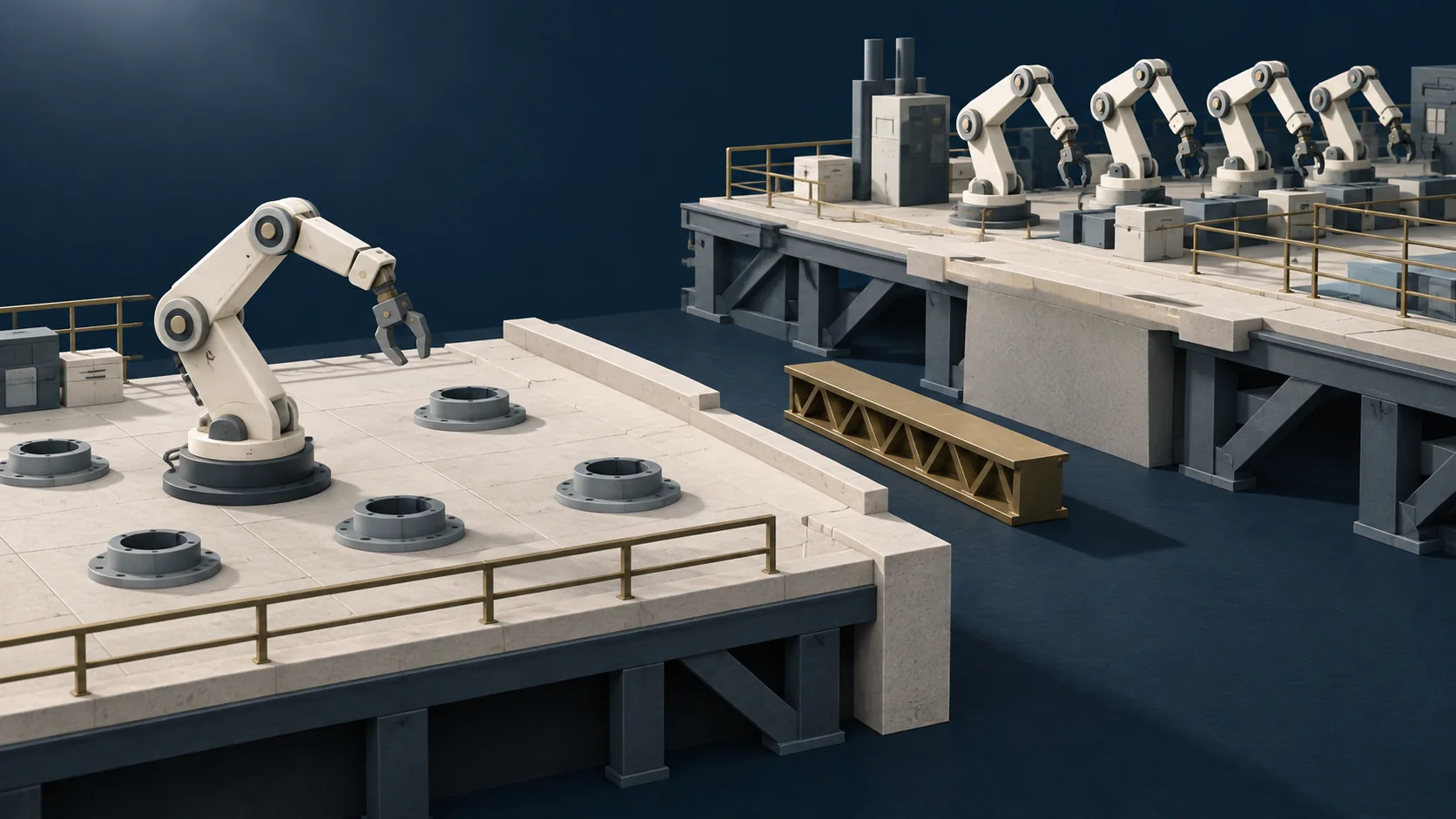
In 2024, China installed 295,000 industrial robots in its factories. The United States installed approximately 34,200. That is not a competitive gap. That is a structural divergence playing out at a ratio of nearly nine-to-one.
According to the International Federation of Robotics' World Robotics 2025 report, China now accounts for 54 percent of all global industrial robot installations, exceeding the combined total of every other market on earth. China's operational robot stock surpassed 2 million units in 2024, the largest of any country. Its robot density reached 470 units per 10,000 manufacturing workers; the US figure sits at 295.
The domestic robotics supply chain tells the same story from a different angle. Chinese robot makers now hold 57 percent of their home market, up from 47 percent just one year earlier, as foreign competitors are systematically displaced. Beijing's 15th Five-Year Plan, launched in 2026, elevates robotics and "embodied intelligence" from a subsidy target into the connective tissue of China's entire economic modernization strategy. Reported government support for the sector reached more than $20 billion in grants, loans, tax credits, and state-backed venture capital across late-2024 and early-2025 alone.
Against that backdrop, the US has not had a unified national robotics strategy.
Bipartisan Architecture, Twelve-Month Clock
The Special Competitive Studies Project, the think tank that emerged from the National Security Commission on Artificial Intelligence, launched the new commission on March 17, 2026. Its co-chairs are SCSP President Ylli Bajraktari, Senator Ted Budd (R-NC), and Senator Elissa Slotkin (D-MI). The bipartisan design is deliberate: robotics for manufacturing has been framed as an industrial capacity issue, not a partisan one.
The commissioner roster reflects the full stack of what a national robotics strategy would need to address: Rev Lebaredian from NVIDIA brings AI infrastructure perspective; Dr. Torsten Kroeger of Intrinsic (Alphabet's industrial robotics unit) brings software and systems integration depth; Heather Carroll of Path Robotics contributes next-generation welding automation; Dr. Ayanna Howard, Dean of Engineering at Ohio State University, anchors the workforce and talent dimension; Peter Barrett of Playground Global brings early-stage capital and hardware development perspective.
The commission's work organizes around four pillars: a unified national framework to synchronize public-private investment; a talent pipeline strategy to scale the domestic pool of robotics engineers and technicians; measurable adoption targets for robotic integration across supply chains; and supply-chain policy to secure US leadership in robotics hardware and software. A final report is expected in March 2027.
Twelve months. That timeline is not incidental; it is a signal about urgency.
What a Strategy Must Reckon With
The policy challenge is not simply one of investment. It is structural. The US robotics industry faces fragmented regulation, supply chain dependencies on foreign components, and slower enterprise adoption rates compared to peer nations. The ITIF's July 2025 analysis, A Time to Act: Policies to Strengthen the US Robotics Industry, identified these structural barriers as the primary drag on deployment velocity. The obstacle is not lack of technology or talent per se, but the absence of the policy scaffolding that makes deployment economically rational at scale.
China's advantage is partly financial (the $20 billion subsidy figure is real and material) but it is also organizational. "Made in China 2025" and the Robot+ plan created aligned national targets with measurable benchmarks. When every tier of the supply chain knows what the government is optimizing for, capital allocates accordingly. The US has had no equivalent signal.
In 2024, China installed 295,000 industrial robots, more than every other country combined. The United States installed approximately 34,200. (International Federation of Robotics, World Robotics 2025)
The commission's mandate to "set strategic targets" addresses this directly. Benchmarks matter not because governments can mandate adoption, but because they create the coordination point that lets industry plan. A manufacturer deciding whether to invest in robotic assembly lines needs confidence that suppliers, workforce training programs, and procurement standards will align. A national target, credibly backed, provides that signal.
What This Means for Manufacturing Leadership
For manufacturing leadership, the commission's launch is less immediately actionable than the underlying data it was created to address. The nearly nine-to-one installation gap is already affecting competitive positioning. Chinese manufacturers deploying at that density are compressing cycle times, reducing defect rates, and driving down unit costs in ways that create pricing pressure across global markets.
The commission's final report, due March 2027, will set the terms for any federal policy response: funding mechanisms, workforce programs, and potentially procurement preferences that advantage US-made robotic systems. Manufacturers who wait for the report before updating their automation roadmaps will have lost a year.
Two practical implications for leadership teams now: First, the talent signal is already clear regardless of what the commission concludes. Robotics engineers and automation specialists are in short supply, and that shortage will tighten as deployments accelerate. Workforce development investments made today will compound. Second, the commission's composition (with NVIDIA's Rev Lebaredian in the room) suggests that physical AI and software-defined manufacturing will be central to the policy recommendations, not just traditional industrial automation. The strategy that emerges will likely blur the line between robotics and AI infrastructure. Executives who have been treating those as separate budget lines may need to revisit that architecture.
Source: SCSP Announces Launch of National Security Commission on Robotics for Advanced Manufacturing Category: Autonomous Robots | Impact: High Impact | Pillar: Industry 4.0