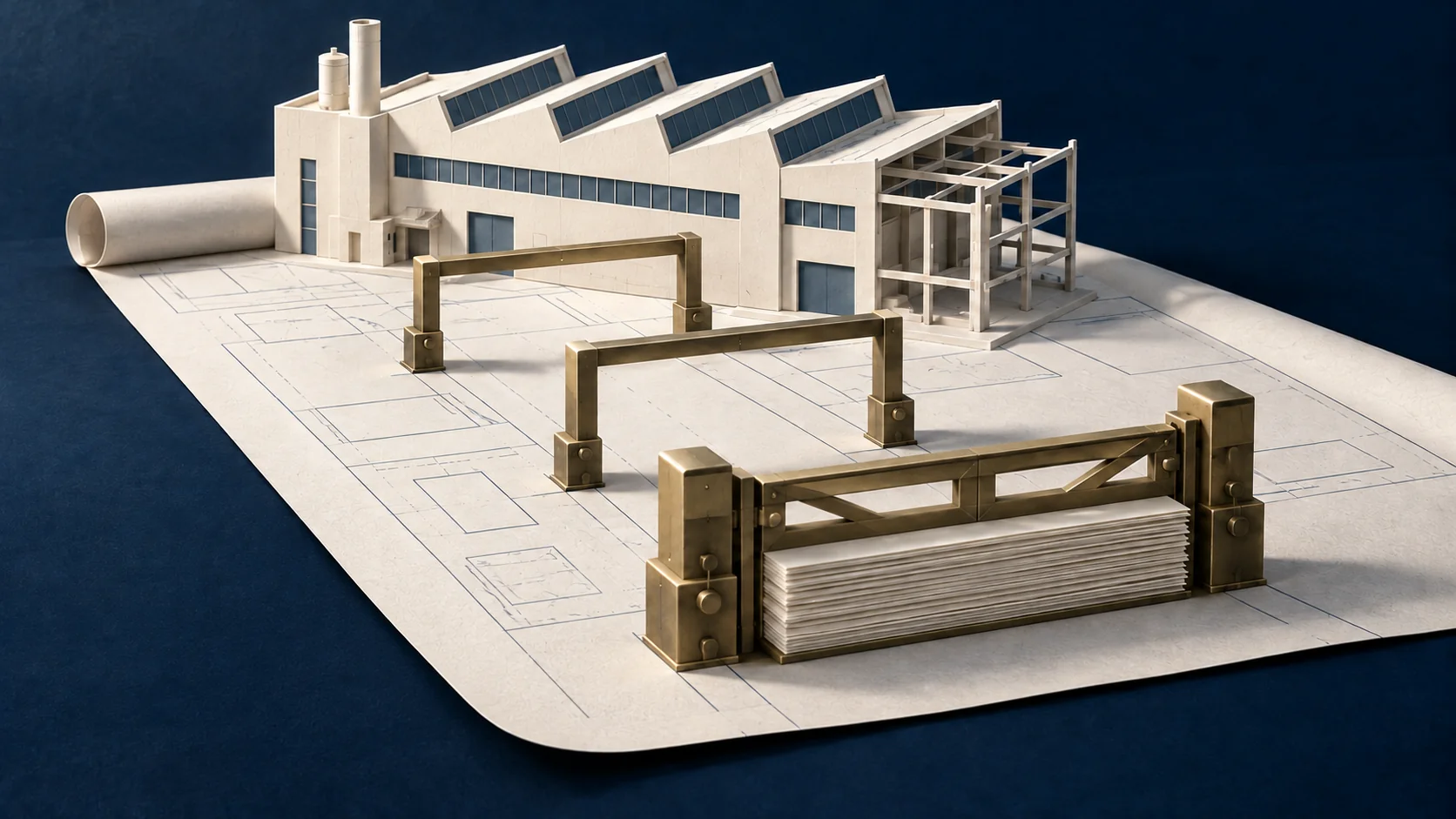
The United States is spending hundreds of billions of dollars to bring manufacturing home. CHIPS Act subsidies, Inflation Reduction Act incentives, direct grants, tax credits. And yet the federal permitting system governing where and when those factories can break ground remains a structure designed for a different industrial era, one where manufacturing permitting delays were an inconvenience rather than a strategic liability.
Executive Summary
- The cost is now quantified: The National Association of Manufacturers and the Frontier Association of Innovation peg the annual drag of permitting delays on U.S. manufacturing at $7.9 billion in foregone investment and capacity expansion.
- The bottleneck has a name: Environmental Impact Statements take an average of 4.1 years to complete, and 72.6% of manufacturing projects requiring federal permits cite the Clean Air Act as the most burdensome regulatory layer.
- The legislative window is narrow: The SPEED Act passed the House 221-196 and awaits Senate action, giving manufacturers a once-in-a-cycle opportunity to push for structural reform.
The $7.9 Billion Drag on Factory Floors
A March 2026 report from the National Association of Manufacturers (NAM) and the Frontier Association of Innovation (FAI), titled "America on Hold," puts a hard number on what plant managers and capital planners have known for years. Federal permitting does not move at the speed of industrial investment.
The $7.9 billion annual figure captures delayed factory construction, deferred equipment installation, and capacity expansion that never materialises because the approval timeline exceeds the investment window. For manufacturers operating on 18-month capital cycles, a 4.1-year average Environmental Impact Statement functions as a veto by calendar rather than a regulatory safeguard.
Perhaps the most striking finding: 87% of surveyed manufacturers said they would expand operations, hire additional workers, or raise wages if the permitting process were streamlined. That is not an abstract policy preference. It is suppressed economic activity with names and addresses.
87% of manufacturers would expand, hire, or raise wages if permitting were streamlined. The bottleneck is not capital or demand. It is paperwork.
Where the System Breaks
The Clean Air Act emerged as the single most burdensome regulatory requirement, cited by 72.6% of manufacturers navigating federal permits. Not environmental review in general, but one specific statute originally enacted in 1970, amended in 1990, and largely unchanged since.
International comparisons sharpen the picture. According to McKinsey's permitting analysis, U.S. federal permitting takes approximately 80% longer than comparable processes in peer nations. A manufacturer weighing a new production line in Ohio against one in Ontario or Bavaria faces a straightforward calculation: same product, same market access, vastly different time-to-production.
Previous estimates relied on anecdotal evidence from individual projects. "America on Hold" surveyed manufacturers directly and aggregated manufacturing permitting delays into a single cost figure that policymakers can no longer dismiss as advocacy arithmetic. The specificity is what makes it different.
For manufacturers already navigating tariff-driven reshoring pressures, the permitting bottleneck creates a compounding effect. Capital committed to domestic expansion sits idle while permits crawl through multi-year review cycles.
One Shot at Reform
The SPEED Act, which passed the House on a 221-196 vote, represents the most concrete legislative vehicle for permitting reform currently moving through Congress. The bill targets NEPA review timelines, imposes deadlines on agency decisions, and creates accountability mechanisms for delays.
Senate passage is not guaranteed. Environmental groups have opposed elements of the legislation, arguing that streamlined review risks weakening protections for communities near industrial sites. The tension is real, but the status quo carries its own cost. When government commits hundreds of millions to domestic manufacturing capacity, permitting delays erode the strategic value of that investment before the first shovel breaks ground.
What This Means for Manufacturing Leadership
Capital planning teams should audit their exposure now. Any facility expansion or greenfield project requiring federal permits faces the 4.1-year EIS average as a baseline planning assumption, not a worst case. Manufacturers with projects in the pipeline should be modelling two scenarios: one where the SPEED Act passes and compresses timelines, and one where it stalls and the current system persists into 2028.
Trade association engagement matters more than usual this quarter. The NAM report gives manufacturers a data-backed argument that did not exist six months ago. The $7.9 billion figure converts permitting reform from an abstract regulatory preference into a quantified competitiveness gap, one with a specific legislative vehicle and a narrow window to act.
Every dollar of reshoring incentive loses value for each month a permit delays the factory it was designed to build. Manufacturers who treat permitting risk as a line item in their capital budgets, rather than an externality to be endured, will make sharper investment decisions about where to build next.
Source: Report: Broken Permitting System Costs Manufacturing $8B Annually Category: Resilience | Impact: High Impact | Pillar: Industry 5.0