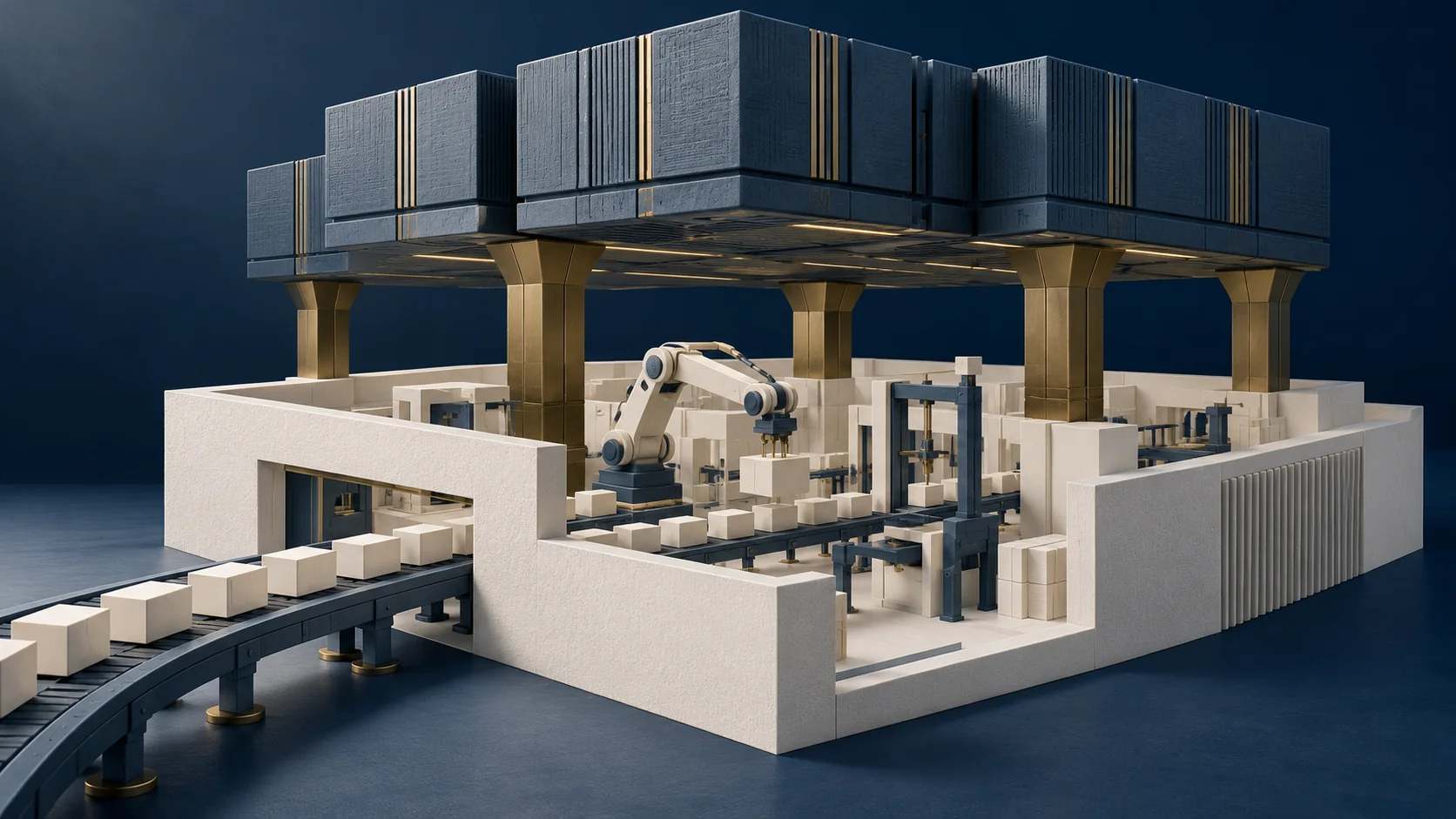
The largest private bet on manufacturing in modern history is not coming from a manufacturer. Jeff Bezos is in talks to raise $100 billion (a figure that would rival SoftBank's Vision Fund at its peak) to acquire industrial companies across aerospace, defense, automotive, and semiconductor fabrication, then rebuild their operations around artificial intelligence. The fund represents the second phase of Project Prometheus, the AI startup Bezos co-founded in November 2025 with former Google X scientist Vik Bajaj. Phase one built the models. Phase two buys the factories.
The Thesis Behind the Trillion-Dollar Ambition
Project Prometheus has already raised $6.2 billion and hired more than 120 researchers from Meta, OpenAI, and DeepMind. But the company's focus is not the chatbot-era generative AI that dominated 2023 and 2024. Prometheus builds what it calls "embodied AI": systems capable of simulating material stress, airflow dynamics, and manufacturing tolerances in real time. The technology targets pre-production processes like prototyping and process optimization, not assembly-line robotics.
A $100 billion acquisition fund converts that R&D into a vertically integrated industrial strategy. Bezos acquires the companies. Prometheus supplies the intelligence layer. Acquired manufacturers become both customers and proving grounds for technology that does not yet exist at scale.
Bezos has reportedly met with sovereign wealth funds in the Middle East and Singapore to secure commitments. The geographic breadth of the fundraising tour signals ambition beyond a single sector or region.
At $100 billion, the proposed fund would be among the largest buyout vehicles ever assembled, a scale of capital deployment that has historically produced as many cautionary tales as success stories.
What Private Capital Already Sees in Manufacturing
Bezos is not operating in a vacuum. Private equity has already accelerated its pursuit of mid-market manufacturers, attracted by stable cash flows and the generational wealth transfer as baby-boomer founders seek exits. According to PwC's 2026 industrials outlook, portfolio reshaping, reshoring incentives, and AI infrastructure demand are driving selective large-scale deals across automation, energy storage, and defense-adjacent sectors.
Their thesis is straightforward: acquire companies with solid operational data but incomplete technology integration, deploy standardized AI tooling across the portfolio, and extract margin gains without building new physical capacity. BDO's 2026 manufacturing predictions confirm that predictive modeling, supply chain analytics, and dynamic production scheduling have moved from pilot programs to competitive prerequisites.
What separates the Bezos play from a typical PE roll-up is the proprietary technology layer. Most private equity firms buy tools from third parties. Bezos is building the tools and buying the companies that will use them. That kind of vertical integration concentrates both the upside and the risk.
The SoftBank Shadow
Any $100 billion technology fund invites comparison with SoftBank's Vision Fund, and the comparison is instructive. SoftBank's first Vision Fund posted a $27.4 billion loss in fiscal year 2022 and followed it with a $32 billion loss the next year. Among the wreckage was Katerra, a construction-technology company backed with over $2 billion that promised to industrialize building. Katerra collapsed in 2021 under the weight of its own operational complexity.
Katerra's lesson is directly relevant: software that works in simulation does not automatically translate to physical production environments where supply chains fracture, labor markets resist, and tolerances are measured in microns. Bezos, who built Amazon's logistics empire from scratch, understands physical complexity better than most technology investors. Whether that experience transfers to aerospace metallurgy and semiconductor fabrication is the open question.
One critical detail remains undefined: the structural relationship between Prometheus and the fund. It is unclear whether the acquisition fund operates under Prometheus's corporate umbrella or whether Prometheus becomes a vendor to its portfolio companies, a distinction with significant implications for governance, conflicts of interest, and operational independence.
What This Means for Manufacturing Leadership
For any manufacturer with revenue above $500 million in aerospace, defense, automotive, or chipmaking, the calculus just changed. A $100 billion acquisition fund with an explicit AI-transformation mandate turns every underperforming plant into a potential target and every slow-moving digital roadmap into a vulnerability.
Panic-buying AI tools is not the answer. What matters now is a clear-eyed assessment of where operational data infrastructure stands today. PE buyers and Bezos-scale acquirers share the same acquisition filter: companies with strong data foundations but unrealized technology potential are the most attractive targets. Companies that have already integrated AI into core processes are harder to acquire at a discount, and harder to argue need new ownership.
The fund is still in talks. Capital commitments are not closings, and $100 billion in ambition does not guarantee $100 billion in deployment. But the signal is unmistakable. The largest pools of private capital on the planet now view manufacturing not as a mature sector to harvest, but as an AI problem to solve. That reframing, more than any single acquisition, is what changes the competitive landscape.
Source: Bezos Seeks $100 Billion for AI-Focused Manufacturing Fund — The Wall Street Journal Additional reporting: Axios, Newcomer, TechCrunch Category: Agent-Driven Economies | Impact: High Impact | Pillar: Intelligent Age