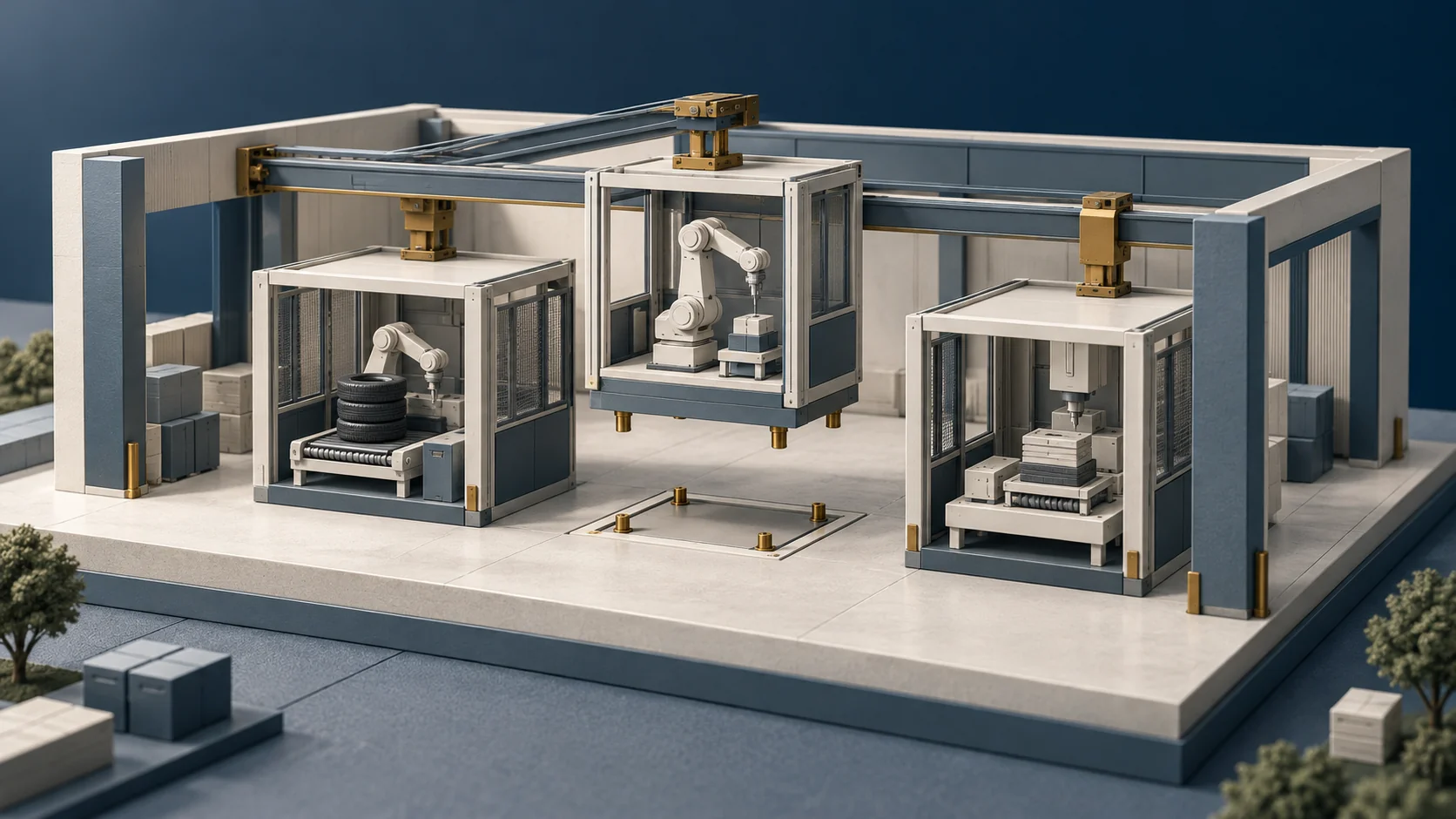
5 million square feet. 500 acres. Tens of thousands of autonomous systems per year. Arsenal-1, Anduril Industries' new facility near Rickenbacker, Ohio, opened approximately three months ahead of schedule in March 2026, and its most consequential feature is not what it produces. Arsenal OS, the digital platform linking design to production across the facility, treats the factory floor as a continuously learning system. The facility switches between Fury airframes, Roadrunner interceptors, and Barracuda cruise missiles with minimal reprogramming. This is software-defined autonomous manufacturing at scale, and it signals a structural shift in how capital-intensive industries will compete.
The Tooling-Free Factory
Traditional defense contractors build a facility for one weapon platform, tool it for that specific design, then hope the military buys enough units to justify the investment. Arsenal-1 inverts this. Anduril invested $1 billion upfront into modular assembly infrastructure capable of switching product configurations through software alone. The facility targets 4,000 jobs by 2035 and is designed to run at a scale that justifies its capital footprint regardless of which specific system the Pentagon orders in any given month.
This is not a one-company model, and that matters. According to Manufacturing Dive, Anduril's $1 billion solid rocket motor facility in McHenry, Mississippi opened in August 2025, the first entirely new U.S. SRM facility in 50 years. Planned capacity: 6,000 tactical motors per year by end of 2026, versus the historical industry baseline of 600 units annually. The Navy, per Manufacturing Today reporting, commissioned Hadrian to build an automated submarine factory targeting autonomous production with minimal human intervention. A pattern emerges: software-driven defense manufacturing is not a single company's bet. It is structural.
The market data confirms it. According to a GlobeNewswire 2025 defense manufacturing market report, AI-driven defense manufacturing is projected to grow from $150 million in 2025 to $1.8 billion by 2030, a 64.9% compound annual growth rate. Defense News reported that defense tech funding nearly doubled from 2024 to 2025 ($27.2 billion to $49.1 billion), with manufacturing-focused deals accounting for $4.7 billion across 39 transactions in 2025 versus $2.6 billion across 24 deals in 2024. Capital is flowing toward software-defined production at scale.
The Supply Chain Vulnerability
Arsenal-1 faces an unspoken constraint: domestic autonomy over semiconductors, sensors, and batteries remains theoretical. China dominates sensor and semiconductor supply chains. Battery production concentration in Asia creates a structural dependency that Arsenal-1's domestic-first positioning has not yet de-risked, and the U.S. robotics policy framework is still years from closing that gap.
The evidence on scale is also mixed. The Department of Defense's Replicator program, according to a 2026 Congressional Research Service briefing, aimed to deliver "thousands" of autonomous systems by August 2025. It delivered "hundreds." Critical technical issues persisted despite $1 billion-plus in investment. A November 2025 Responsible Statecraft analysis reported that Replicator failed to meet both timeline and volume targets. Autonomous systems manufacturing at scale remains unproven under real-world operational constraints: sensor degradation, supply chain interruptions, adversarial jamming, and machine-learning behavior that is intrinsically difficult to predict outside controlled environments, as documented by Stop Killer Robots' 2025 technical assessment.
"Replicator delivered hundreds of systems — not the thousands promised by August 2025."
The implication is not that Arsenal-1 will fail. The implication is that Anduril is betting on a model that the rest of the defense industrial base has not yet validated at scale.
The Regulatory Advantage
What pushes Arsenal-1 forward despite these unknowns is regulatory structure. The DoD Replicator Initiative and the Defense Autonomous Warfare Group (DAWG under SOCOM) have explicit mandates for all-domain autonomous systems at "multiple thousands" scale. FY2026 NDAA language, per Miller Chevalier's government contracts analysis, prioritizes "commercially available" solutions over traditional defense primes, a structural advantage for Anduril's positioning.
No international consensus exists on autonomous weapons regulation. Arms Control Association reporting from early 2025 noted that geopolitical tensions have blocked any global framework, while the U.S. races to field systems. The regulatory vacuum enables Anduril's expansion timeline.
Historical precedent supports the model. During World War II, Ford and General Motors repurposed assembly lines for tanks and aircraft, building modular tooling that could shift production at short notice, a story documented by Arthur Herman in "Freedom's Forge" and analyzed by Karve International's defense foundry work. Arsenal-1 mirrors that strategy for software-defined systems. The Marine Corps' Operation StormBreaker (2023) built a software factory on AWS infrastructure, establishing cultural precedent for rapid deployment cycles now spreading into hardware manufacturing. Globally, per Taylor Wessing's 2025 defense industry analysis, Renault and Kawasaki have entered UAV manufacturing collaborations, further evidence that industrial firms outside traditional defense are moving toward autonomous production.
And the larger private capital thesis converges on the same bet: manufacturing advantage flows to companies that embed software-defined optimization into physical production before the window closes.
What This Means for Manufacturing Leadership
For CEOs and boards, Arsenal-1's opening inside a defined regulatory window frames a capital allocation question that will not stay open indefinitely. Should your company invest in software-defined, modular manufacturing capacity now, or wait for the technology to mature?
The historical precedent from WWII retooling suggests first-movers lock in irreversible structural advantages. Anduril's $1 billion bet is predicated on deploying at scale before international consensus closes the regulatory window on autonomous systems. Defense contractors face this choice within the next 18 months: retrofit existing facilities toward modular architecture and software-defined production, or risk losing market position to pure-plays who move first.
For manufacturers outside defense (automotive, semiconductor, pharmaceuticals) the regulatory urgency is lower, but the economic logic is identical. Watching Arsenal-1's 2027-2028 output metrics provides the validation data that commercial operators need before committing comparable capital. The question a board should be asking today: if a competitor moves to software-defined production and we do not, what is the unit cost disadvantage in five years? The constraint is not technology. The constraint is timing.
Source: Inside Anduril's Big Gamble: An Ohio Weapons Factory Category: Autonomous Robots | Impact: high_impact | Pillar: Industry 4.0