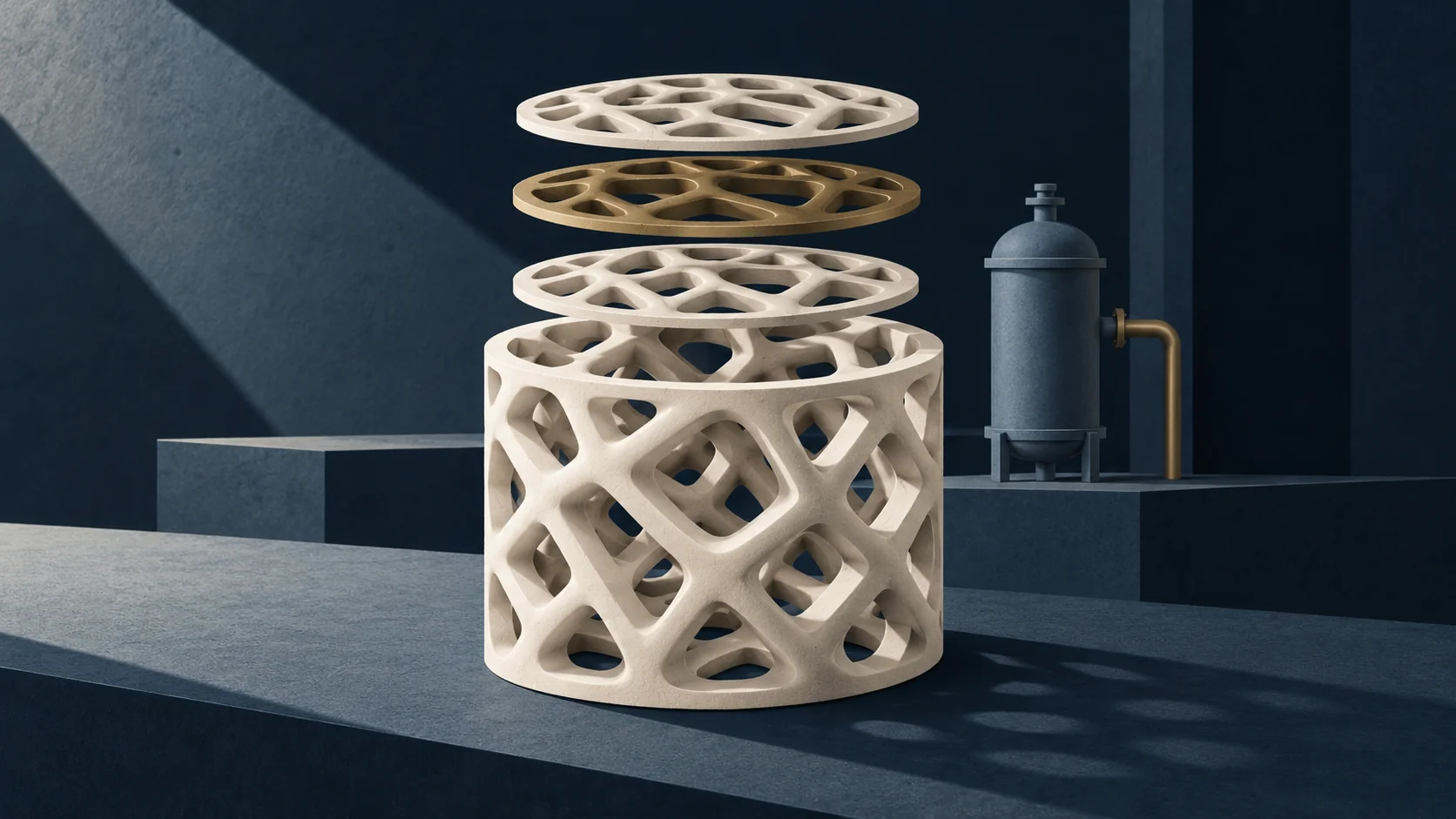
The geometry of a catalyst just became a design variable. That sentence sounds unremarkable until its implications settle: for more than a century, chemical manufacturers have accepted the physical shapes available from pellet presses and extrusion dies as a fixed constraint. BASF's commissioning of the world's first industrial-scale 3D-printed catalyst plant on March 19 at its Ludwigshafen headquarters changes that constraint into a choice.
The Quiet End of a Manufacturing Ceiling
The facility produces catalysts using BASF's proprietary X3D technology, which applies additive manufacturing to create catalyst geometries that conventional shaping methods cannot achieve. The core engineering trade-off in reactor design has always pitted two variables against each other: catalytic surface area and pressure drop. Increase the surface area by packing catalysts more tightly, and pressure drop rises, demanding more energy to push feedstock through the reactor. Open the structure to reduce pressure drop, and active surface area falls.
X3D-printed catalysts break that trade-off. The technology produces structures that combine high mechanical stability with open internal architecture, simultaneously reducing pressure drop and increasing catalytically active surface area. For plant operators, the arithmetic is straightforward: higher reactor throughput, improved product quality, and lower energy consumption from the same installed equipment.
BASF has been supplying X3D catalysts to production plants for several internal and external customers for years — but until now, only at pre-industrial scale.
The Ludwigshafen plant moves this from limited supply to full commercial availability. The technology applies across precious and base metal catalysts and multiple support materials, which means the addressable market extends from petrochemical refining to fine chemicals to environmental catalysis.
From Anecdote to Operating Data
The proof point that matters most sits in Anhui province, China. In 2025, fine chemical producer An Hui Jintung retrofitted its sulfuric acid production plant with BASF's O4-115 X3D catalysts. The company reported a smooth startup followed by record production levels, a meaningful data point because sulfuric acid production is one of the chemical industry's most mature, most optimized processes. Finding performance headroom in a century-old process through geometry alone suggests the improvement mechanism is genuine, not theoretical.
Academic research supports the broader claim. A 2022 review published in Frontiers in Chemical Engineering found that additively manufactured catalyst structures enable process intensification by optimizing heat transfer, mass transfer, and fluid dynamics simultaneously, capabilities that conventional pellet or monolith shapes cannot match. The gap between laboratory demonstrations and industrial deployment was, until this month, the missing piece. Ludwigshafen fills it.
The chemical industry context matters here. Global catalyst demand exceeds $35 billion annually, and reactor efficiency directly drives operating margins for every chemical manufacturer running continuous processes. Even single-digit percentage improvements in throughput or energy consumption compound into substantial value across a fleet of reactors operating around the clock.
What This Means for Manufacturing Leadership
Three implications deserve attention from executives beyond the chemical sector.
First, this is additive manufacturing's clearest proof of production-grade deployment outside aerospace and medical devices. The narrative around 3D printing has been stuck in "promising but pre-industrial" for a decade. A facility at BASF's flagship site, supplying paying customers with performance data, changes the credibility calculation for AM investment cases in adjacent industries.
Second, the competitive dynamics of catalyst supply just shifted. Catalyst manufacturers who cannot offer geometry-optimized products will face a structural disadvantage as early adopters demonstrate measurable efficiency gains. The window to evaluate X3D-equivalent capabilities in existing catalyst procurement is open now — it will not stay open indefinitely.
Third, the broader pattern is worth watching: when a manufacturing constraint that has persisted for a century suddenly becomes a design parameter, the second-order effects tend to be larger than the first. Reactor designs optimized around the limitations of conventional catalysts may themselves need rethinking. That is a longer conversation, but it starts here.
Source: BASF launches world's first plant for the production of 3D-printed catalysts Additional reporting: BASF press release, March 2026; Frontiers in Chemical Engineering, 2022 Category: Additive Manufacturing | Impact: High Impact | Pillar: Industry 4.0