The announcement that matters most from GTC 2026 is not a new chip. It is a repositioning: NVIDIA is moving from selling hardware to manufacturers into becoming the compute infrastructure that manufacturing runs on.
The Platform Play Beneath the Press Releases
At GTC 2026, NVIDIA formalized partnerships with five of the most deeply embedded industrial software companies on earth (Siemens, Dassault Systèmes, PTC, Cadence, and Synopsys) to integrate NVIDIA CUDA-X acceleration and Omniverse simulation libraries into their products. The manufacturers on the receiving end of this infrastructure are not small-scale pilots. They include FANUC, HD Hyundai, Honda, JLR, KION, Mercedes-Benz, MediaTek, PepsiCo, Samsung, SK Hynix, and TSMC.
The significance here is structural. When Siemens embeds Omniverse libraries into its Digital Twin Composer, every Siemens customer operating a factory becomes, functionally, an NVIDIA infrastructure customer, without NVIDIA appearing anywhere in the procurement conversation. This is the same playbook NVIDIA ran in AI: become the layer that every serious player builds on, then let adoption compound across the market.
Siemens' Digital Twin Composer is the most concrete near-term expression of this. Early deployments at manufacturers including Foxconn, HD Hyundai, PepsiCo, and KION are showing measurable results: a 20 percent increase in throughput at initial sites, identification of up to 90 percent of potential issues before physical implementation, and a 10 to 15 percent reduction in capital expenditure by validating investments virtually before committing to physical builds. Those numbers, from Siemens' own announced figures, represent the kind of industrial return that board-level capital allocation decisions respond to.
Where the Physical AI Term Has Real Meaning
Jensen Huang's phrase "physical AI," used repeatedly in the GTC keynote, risks sounding like marketing language. The actual deployments give it content.
SK Hynix is using NVIDIA's Omniverse platform as a foundation for its autonomous fab initiative, targeting full autonomy by 2030. Samsung is implementing Omniverse digital twins across its manufacturing facilities while applying CUDA-X-accelerated software from Cadence and Synopsys for computational lithography, the compute-intensive process verification step that determines whether advanced chip manufacturing scales. When physical process windows at 2nm and below are measured in angstroms, the simulation fidelity of the digital twin is not a productivity tool. It is a manufacturing prerequisite.
FANUC, the world's largest maker of industrial robots, announced it is combining its robotics systems with NVIDIA Isaac Sim, Omniverse, and IGX Thor processors to improve digital twins, reduce robot setup time, and enable real-time AI on the factory floor. For manufacturers deploying FANUC systems (which covers most of the automotive and electronics sectors globally) this integration means the robot's simulation environment and the factory's digital twin increasingly share the same underlying compute architecture.
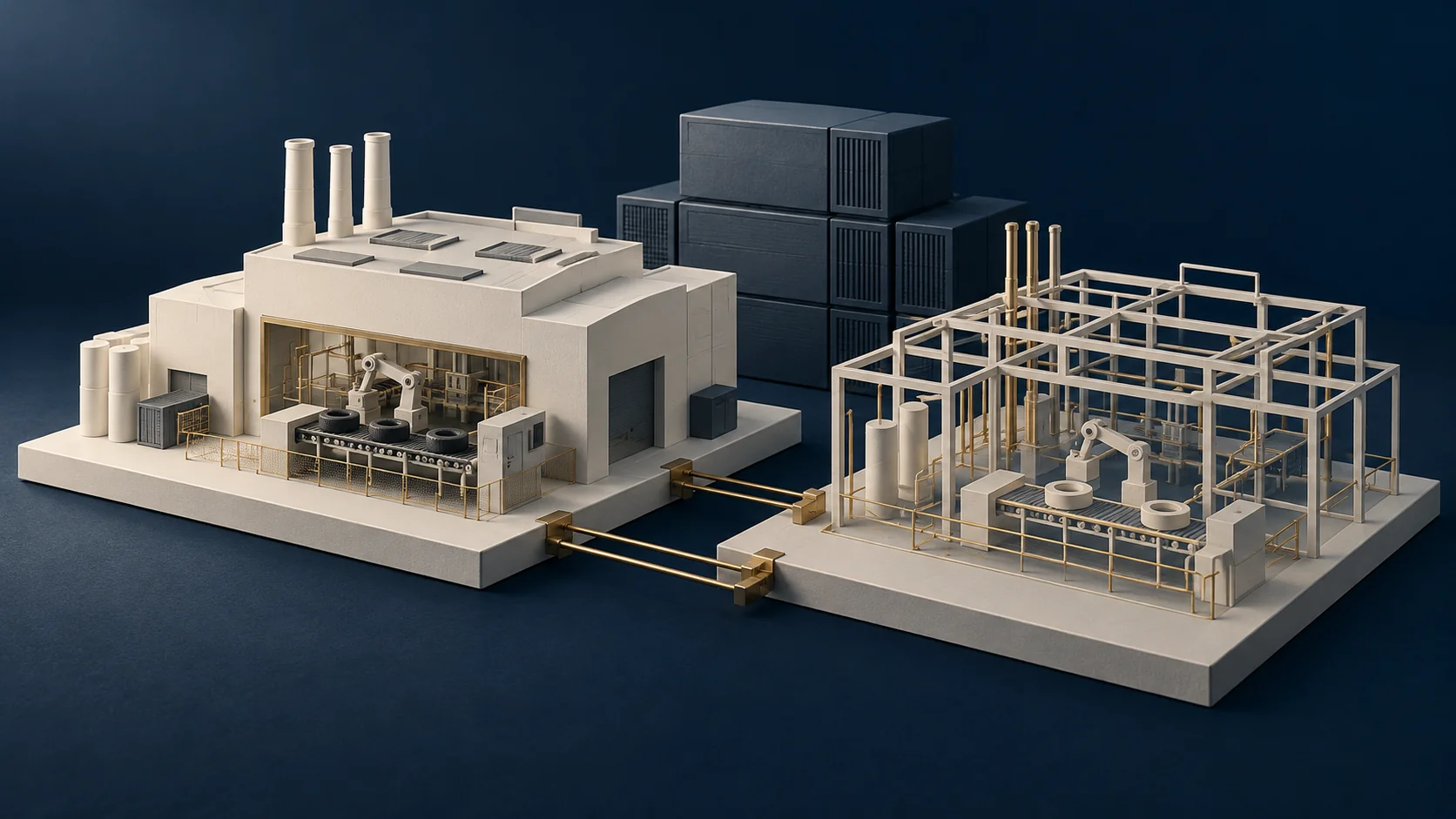
The Siemens Electronics Factory in Erlangen, Germany, is slated to become the first deployment site of the joint Siemens-NVIDIA vision of a "fully AI-driven, adaptive manufacturing site," announced initially at CES 2026 and reinforced at GTC. The concept involves an AI brain integrating software-defined automation and Omniverse libraries to continuously analyze a live digital twin, test operational changes virtually, then deploy validated decisions to the shopfloor in near real time.
"Early results show a 20 percent increase in throughput at initial sites, nearly 100 percent design validation, and a 10 to 15 percent reduction in capital expenditure." — Siemens, on Digital Twin Composer deployments with NVIDIA Omniverse
What This Means for Manufacturing Leadership
The implications vary by where a manufacturer sits in the technology adoption curve. For those already operating Siemens or Dassault Systèmes environments, the NVIDIA integration is largely transparent; the capability arrives through software updates, not a new procurement process. The question for leadership teams is whether to lean into the physics-accurate simulation workflows that Omniverse enables or continue running lower-fidelity digital twins that leave potential gains on the table.
For those evaluating new automation or simulation platforms, GTC 2026 reinforced that the market is consolidating around NVIDIA as the compute substrate. PTC's CAD-to-Isaac Sim pipeline, Dassault's virtual twin integration, and Siemens' Digital Twin Composer all point to a world where NVIDIA GPU infrastructure is implicit in serious industrial simulation. The vendor selection question shifts: it is no longer whether to run GPU-accelerated simulation, but which software layer to run on top of it.
The Erlangen factory is worth watching specifically. If Siemens and NVIDIA deliver a credible demonstration of adaptive manufacturing, where the digital twin actively drives operational decisions rather than just monitoring them, it will set the reference architecture that the rest of the sector benchmarks against. The first site to prove the model tends to define the standard.
Source: From GPUs to factory floors, Nvidia redefines manufacturing landscape Category: Simulation/Digital Twins | Impact: High Impact | Pillar: Industry 4.0